
How a Two-Person Studio Uses AI Without Losing the Human Thread
Series note
This is Part 2 of our four-part Field Notes series on AI-era leadership. In Part 1, we shared how AI moved from being a useful tool in our studio to becoming part of the way work moves. Here, we are looking at what that means inside a two-person studio, where shared context and clear ownership matter every day.
How a Two-Person Studio Uses AI Without Losing the Human Thread
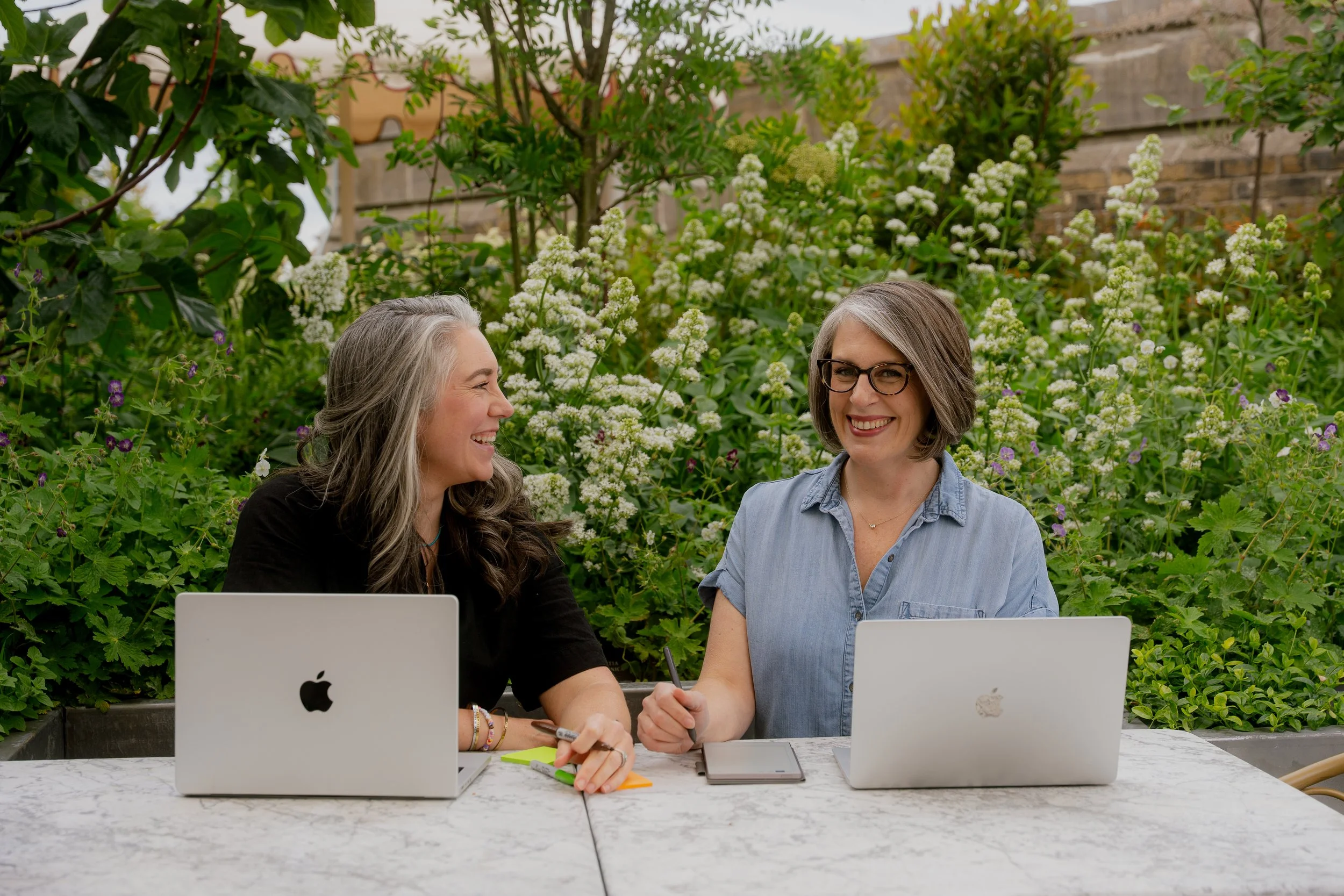
Leah and I built Gather & Grow into what it is today, just the two of us.
There are no layers of management behind the scenes. No hidden delivery team. No big content department. Most of the time, when people find out how much we are running (Growth Map, leadership programmes, client work, community roles, our own content and The New Terrain) they assume there must be a bigger team somewhere.
There is not.
There is Leah, and there is me. It’s just the two of us now, but we did, very recently, have a stellar Marketing Lead, who supported us 8 hours per week.
In order to make this work, there is a way of working we have had to build very intentionally around the two of us.
That includes the AI systems we use every day. Some are practical and operational, like the Story Harvester and inbox agents we mentioned in Part 1. Others sit closer to the creative work: drafting newsletters, shaping campaigns, developing Field Notes and helping us find the clearest language for what we are seeing in the work.
One of the most useful examples is the writing assistant we built inside Notion. It is a persona prompt that acts as a writing coach and copywriter for Gather & Grow. It understands our voice, our audience, our current AI-era leadership positioning and the kinds of phrases we want to avoid. It helps us draft, refine and pressure-test how we talk about our work publicly.
That does not mean the writing is outsourced. The judgement stays with us. The lived experience is ours. The point of the assistant is to help us stay close to our own voice while making the work easier to begin, shape and sharpen.
That is the honest answer to how the studio carries what it carries, and no one single tool is doing something magical. We have intentionally welcomed in AI into the places where friction used to slow us down, and we have built enough shared context around the work that everything does not have to sit in one person's head.
Capacity is only part of the story
It would be easy to make this about productivity, and SO MANY stories you read these days are about more, more, more - but not here.
AI helps us move faster. It reduces friction. It lightens some of the repetitive load. All of that is true.
But, for us as a team of two, capacity is only part of the story. The deeper reason this works is because the work has somewhere to land.
We have clearer lanes. We have shared context. We have a central workspace where client work, content, meeting notes, programme design and internal thinking live. We have enough trust in the system, and in each other, that one person does not have to hold every thread at once.
AI helps us become more intentional about how work moves between us.
What this looks like week to week
On any given week, Leah and I might be running client engagements, developing programme content, showing up for community roles and making space to write and think publicly about growth and leadership.
A few years ago, that workload would have needed a much bigger team. Right now, it needs two people who know how to work with AI well, and who are willing to keep refining the system around it.
The Story Harvester means content does not require a separate research phase. The material is already there, drawn from real conversations, by the time one of us sits down to write.
The writing assistant helps us turn that raw material into newsletters, campaigns, Field Notes and clearer language around our point of view.
The inbox agents mean less time lost to admin.
Our shared Notion hub means Leah and I are less likely to duplicate each other's thinking, or work from different versions of the truth.
That shared context matters. Without it, AI would create more output for us to manage. With it, the tools support better delegation, cleaner handoffs and more shared ownership between the two of us.
They help us notice where something is stuck, rather than relying on one person to keep the whole studio map in their head.
The trade-off
We would be lying if we said this was all upside.
Being two people means we both wear more hats than we would in a bigger team, and AI does not remove that. There are still days where the number of things we are holding feels like a lot, tools or no tools.
Building our own systems also takes real time up front. A bigger company might buy more off the shelf. We have chosen to build a way of working that fits closely around how we think, facilitate, coach and create.
That trade feels right for us.
We get to stay small, close to our clients and genuinely hands-on with the work, without limiting how much we can hold as a studio.
For any small team exploring AI, the question is not only, "What could this help us do faster?"
A better question might be:
If we added more AI tomorrow, would the work move more clearly, or would it create more output for the same few people to carry?
That is where the leadership work begins.
Keep reading
In Part 3, we share the actual AI toolkit we use at Gather & Grow, including the writing assistant, and why the behaviours around the tools matter more than the platforms themselves.
In this series
